Crypto & blockchain tracing.
Bitcoin, USDT and crypto tracing for scam victims, lawyers and the courts across Australia and New Zealand. I follow the funds hop by hop to the exchange where they were cashed out, and write it up as evidence that holds up under cross-examination.
Follow a trace, hop by hop
Three typical cases, laid out the way a real trace reads. Press Play trace to follow the money, drag any wallet to move it, and click a wallet or a payment to see why it's labelled the way it is.
What is crypto tracing?
Crypto tracing, also called blockchain tracing or blockchain forensics, is following cryptocurrency from wallet to wallet on the public ledger until it reaches a point where a person can be identified. Usually that point is an exchange, which holds the account holder's ID.
Every Bitcoin, Ethereum, Tron and Solana transaction is recorded permanently and publicly. Wallet addresses aren't names, so crypto feels anonymous. In practice, money has to land somewhere it can be spent, and most of it ends up at a regulated exchange. A trace connects the payment you made to that exchange account, step by step, with a transaction ID for every hop that anyone can check.
Bitcoin tracing
Bitcoin is traced coin by coin. Each payment spends earlier outputs and creates new ones, including "change" back to the sender. Telling the payment from the change, and spotting wallets that belong to the same owner, is the core skill. CoinJoin and peel chains are where traces are won or lost.
USDT and stablecoin tracing
Most investment scams in Australia and New Zealand now run on USDT, usually on Tron, sometimes Ethereum. Stablecoins move fast and cheaply between many wallets, but every transfer is on-chain, and the issuer can freeze USDT at an address when law enforcement asks.
Ethereum and token tracing
On Ethereum and networks like Base, Arbitrum and BNB Chain, funds move through tokens, smart contracts and decentralised exchanges. A trace follows the value through swaps, so a USDC payment that comes out the other side as ETH is still followed.
Cross-chain tracing
Scammers move funds between blockchains to break the trail, through bridges and services like THORChain. Most bridges keep public records of each transfer, so the trace picks up on the destination chain and carries on.
Who I trace crypto for
The method is the same in every case. What changes is who needs the answer and how it has to be written.
Scam victims
Investment, romance and "pig butchering" scams. A trace shows where your money went and gives police and the exchange what they need to act.
Lawyers and litigators
Tracing for freezing orders, disclosure applications and claims against the people holding the funds, written as expert evidence from the start.
Family Court matters
Finding crypto a party hasn't disclosed in a property settlement or relationship property case, and valuing it at the separation date.
Criminal proceedings
Independent analysis for the prosecution or the defence: fund flows, wallet attribution and laundering patterns, explained so a jury can follow.
Insolvency and estates
Liquidators, trustees and executors who need to find crypto a company or a deceased person held, and where it went.
Businesses
Hacks, ransomware payments, payment redirection and insider theft, traced to the point where funds can be frozen or reported.
How a crypto trace works
Every trace runs in this order. Each step is written down as it happens, so the finished report shows exactly how each conclusion was reached.
Confirm what was sent
Your transaction IDs, wallet addresses, amounts and dates are checked against the blockchain, so the trace starts from verified payments, not from memory.
Follow the funds
Each payment is followed hop by hop, through splits, consolidations, peel chains and swaps, until it stops at an exchange, a mixer or a wallet that still holds it.
Group wallets by owner
Clustering links wallets controlled by the same person, so a scattered trail becomes one picture of who holds what.
Find the cash-out point
Exchange deposit addresses are identified. These are the details an exchange needs to find the account holder and freeze what's left.
Value it
Every hop is valued in AUD or NZD on the day it happened, which matters for court, property settlements and insurance.
Report it
A written report with the trace graph, every transaction ID, and the basis and confidence for every label. Built to be checked by the other side.
Blockchains and assets I trace
Coverage for the networks scams and disputes actually use, including the bridges and swaps used to hop between them.
Why I built my own tracing software
Blockchain tracing software is wildly overpriced. Chainalysis, the name most tracing firms like to quote, doesn't publish its prices. UK government procurement listings put a single licence for its Reactor tracing tool at between £10,500 and £55,000 a year. TRM Labs and Elliptic sell into the same government and banking market, on quote-only pricing.
Those tools are priced for governments and banks, and tracing firms pass that cost straight on to scam victims who have already lost money. Meanwhile the data is free: every transaction sits on a public blockchain anyone can read. What those licences really sell is a graph and a database of labelled addresses.
So I built my own. My in-house tracing software does the work those tools are bought for and keeps the cost of a trace down. It also means there's no black box. When opposing counsel asks how a wallet was attributed or why a trace turned left instead of right, I can explain the exact rule that made the call, its limits and how confident it is, because I wrote it.
- Follows the funds hop by hop: exact coin tracing on Bitcoin, amount-capped tracing on Ethereum, Tron and Solana. Every hop explains itself.
- Finds exchange deposit addresses, the detail an exchange needs to identify an account holder.
- Clusters wallets by common ownership, and flags CoinJoin, Tornado Cash and other mixers.
- Crosses chains through bridges and DEX swaps instead of stopping at them.
- 185,000+ labelled addresses covering exchanges, scams, sanctions, hacks and darknet markets, each with its source and a trust level.
- Exports a printable report with a fingerprint of the facts, so nobody can quietly change it later.
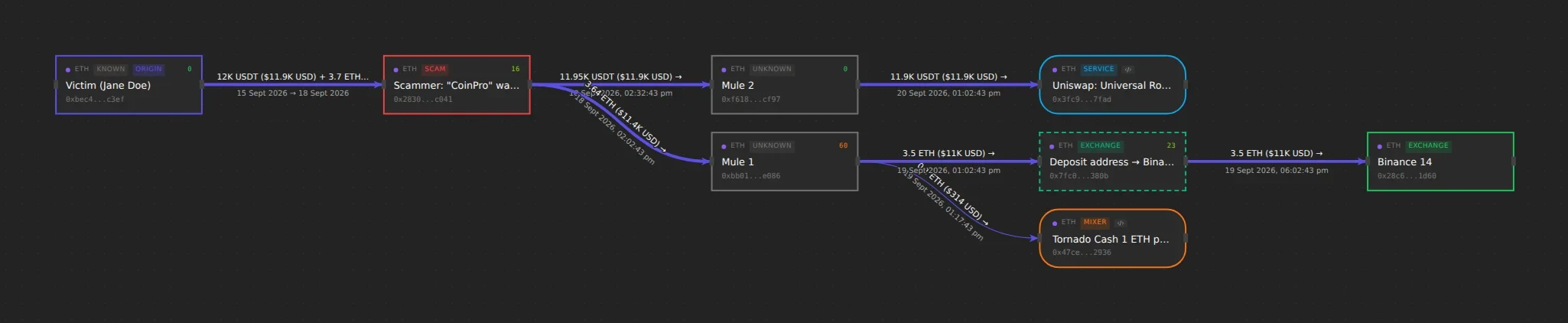
What's in a crypto tracing report
Written for the person who has to act on it: a police officer, an exchange compliance team, a lawyer or a judge.
The trace graph
A clear diagram of where the money went, from your payment to where it stopped.
Every transaction ID
Each hop with its transaction hash, amount, date and value, so anyone can check it on a public block explorer.
Exchange deposit addresses
Where funds were cashed out, which exchange it was, and what to quote in a freeze or disclosure request.
The basis for every label
Why a wallet is called an exchange, a mixer or a scam, where that label came from, and how confident it is.
Values in AUD or NZD
Valuations on the dates that matter: when funds were sent, when they moved, or the separation date.
A plain-English summary
One page a police officer or judge can read in two minutes, with the technical detail behind it.
Crypto tracing work in court
A selection of real matters. Details are anonymised; the case work page has more.
Homicide trial, instructed by the Crown
Traced fund flows across multiple wallets and networks, attributed wallets to the defendant, and analysed the laundering patterns. Explained blockchain tracing to the jury and was cross-examined at trial.
Concealed crypto in property settlements
Across a number of matters, traced cryptocurrency one party hadn't disclosed and reported it to the party seeking the information. Concealed holdings ranged from AUD 500,000 to AUD 5 million per matter.
Relationship property, Auckland
Identified, traced and valued Bitcoin, Ethereum, NFTs and DeFi positions at the separation date, using clustering to establish who owned which wallets and when. Gave oral evidence at the hearing.
Criminal proceedings, defence-instructed
Independent expert report on the cryptocurrency transactions and on-chain evidence the prosecution relied on.
Can traced crypto be recovered?
Sometimes, and a trace is the first step. Tracing on its own doesn't move money back. It produces the evidence that police, lawyers and exchanges need to freeze funds and identify who holds them. Recovery then happens through a police request to the exchange, a court freezing order, or a civil claim against the account holder.
Speed matters. Funds sitting in an exchange account or as USDT can often be frozen. Funds already withdrawn as cash usually can't. If money moved in the last few days, say so when you get in touch.
Watch for recovery scams. After a scam, victims are often contacted by "recovery agents" who promise to hack the funds back for an upfront fee. Nobody can do that. Here's how to tell the difference.
| What to check | Legitimate tracing | Recovery scam |
|---|---|---|
| Promises | Tells you what's realistic before you pay, including when the answer is no | Guarantees recovery, often with a success rate |
| Method | Traces public transactions and works through police, lawyers and exchanges | Claims to "hack" the scammer or use secret software |
| What you get | A report with transaction IDs you can check yourself | Vague progress updates and requests for more fees |
| Who they are | A real name, a court record and a business you can look up | An anonymous account that contacted you first |
| What they ask for | Transaction IDs, addresses and screenshots | Your seed phrase, remote access or "release fees" |
Crypto tracing in Australia
If you've lost crypto to a scam in Australia, report it to ReportCyber at cyber.gov.au and to Scamwatch, and contact the exchange or bank you paid from straight away. IDCARE offers free support for victims of scams and identity crime. A trace report gives police and exchanges the transaction IDs and deposit addresses they need to act on it.
Australian exchanges must register with AUSTRAC and verify who their customers are, which is why finding the exchange deposit address matters so much. In civil matters, lawyers use a trace to support freezing orders and applications that make an exchange hand over account records. In Family Court property settlements, crypto falls under the duty of full and frank disclosure, and a trace can show holdings that were left out. My guide to crypto expert witnesses in Australia covers the court side in detail.
I work with individuals and law firms in Sydney, Melbourne, Brisbane, Perth, Adelaide and Canberra, and through Crypto Consulting AU.
Crypto tracing in New Zealand
In New Zealand, report crypto scams to NZ Police online through 105 and to Netsafe, and contact the exchange or bank you paid from. My guide to crypto scams in NZ covers what to do straight away.
NZ exchanges are reporting entities under the AML/CFT Act and must identify their customers. In Ruscoe v Cryptopia (2020) the High Court held that cryptocurrency is property, so it can be traced, frozen and claimed like any other asset. Under the Property (Relationships) Act, crypto is divided like any other relationship property, and a trace can show holdings a partner didn't disclose. See my guide to crypto in NZ relationship property cases.
I'm based in Ōtautahi Christchurch and work with clients in Auckland, Wellington and across Aotearoa, and through Crypto Consulting NZ.
Crypto tracing questions
Can Bitcoin be traced?
Yes. Every Bitcoin transaction is recorded permanently on a public ledger. Addresses aren't names, but by following the coins hop by hop you can usually find where they reached an exchange, and exchanges in Australia and New Zealand must verify who their customers are.
Can USDT be traced?
Yes. USDT on Tron (TRC-20) and on Ethereum (ERC-20) is as traceable as Bitcoin, and it's the currency most investment scams now use. Tether, the company that issues USDT, can freeze it at an address when law enforcement asks, which makes a fast, accurate trace especially valuable.
How much does crypto tracing cost?
It depends on how many payments, wallets and blockchains are involved, and whether you need a court-ready expert report or a summary for police and an exchange. After a short look at what you have, you'll get a quote before any work starts, and I'll tell you if a trace isn't worth paying for.
How long does a crypto trace take?
A single-chain trace that ends at an exchange is much quicker than one that crosses bridges, mixers or dozens of wallets. You'll get a timeframe with the quote. If the funds moved in the last few days, say so, because that's when a freeze is most likely to work.
Can you trace crypto through a mixer or CoinJoin?
Sometimes. Mixers and CoinJoin transactions are built to break the link between coins going in and coming out. Some, like Tornado Cash, can be partly unpicked through amounts and timing. Where a trace can't be followed with confidence, the report says so and says why, rather than guessing.
Can a trace identify the scammer?
Not by name on its own. A trace identifies the exchange accounts the money went to. The exchange knows who owns those accounts, and police or a court order can require it to say. That's why the deposit address is the most important finding in most traces.
Will a crypto tracing report stand up in court?
That's what it's written for. I've given expert evidence on crypto tracing in New Zealand and Australian courts, and been cross-examined on it at trial. Every hop is documented with its transaction ID, and every label shows its source and how confident it is, so the other side can check the work.
Can you get my crypto back?
Tracing doesn't move money back by itself. It gives police, lawyers and exchanges what they need to freeze funds and identify who holds them. Be very wary of anyone who promises to recover scammed crypto for an upfront fee. That is almost always a second scam.
What do I need to start a trace?
The transaction IDs (hashes) of your payments, the wallet addresses you sent to, the amounts and dates, the exchange or wallet you paid from, and screenshots of the platform or messages. Never send anyone your seed phrase or private keys.
Do you trace crypto outside Australia and New Zealand?
Yes. Blockchains don't stop at borders, so most traces cross several countries anyway. US clients and law firms are looked after through Crypto Consulting USA.
Read next
Crypto tracing across three countries
Tracing work is delivered through the practice in your region. Get in touch here and I'll point you to the right one, or go direct.
Crypto Consulting AU
Crypto tracing, scam investigation, and court and legal case support for Australians.
Visit siteCrypto Consulting NZ
Scam analysis, blockchain tracing and wallet recovery for clients across Aotearoa.
Visit siteCrypto Consulting USA
Blockchain forensics and wallet recovery for American clients and law firms.
Visit site